
Last Updated On December 29, 2025
Many advanced lifters perform overhead presses and push presses. The movement looks very similar for each, so how do you know which is best for you?
The gym can be a confusing enough place already, so in this guide, we'll help explain the key differences between each exercise and give you the full breakdown of push press vs. overhead press.
Push Press Vs Overhead Press (Which One Should You Do?)
It’s easy to get push press and overhead press confused, so here’s a quick guide on which is most beneficial depending on your goals:
Strength Gains
Both push presses and overhead presses will help to increase your strength. Push presses involve your whole body and are a power exercise. This means you'll feel the benefit in your whole body, but less acutely.
If you want to make focused strength gains, then the overhead press is best because it isolates your deltoids, shoulders, and upper back. This forces them to work harder and makes them noticeably stronger.
If you want to improve your overall physicality and functionality, then you're better with a push press, but if you want to really target your upper body and build your strength, then you should go for an overhead press.
Related Article - Overhead Press Vs Bench Press

Hypertrophy
Hypertrophy refers to the increase in muscle size or muscle mass. This is generally caused by your body working hard to overcome a problem and the muscle growing as a result.
A push press will stimulate hypertrophy with the explosive upwards movement and the controlled negative on the way down. An overhead press will also lead to hypertrophy because of the controlled movement focused on your upper body.
If your goal is hypertrophy, then the overhead press is slightly more beneficial. However, performing a mix of push presses and overhead presses in one set is the best way to grow larger muscles more quickly.
Fat Loss
Fat loss is caused when your heart starts to beat fast and your metabolic rate increases [1]. This usually occurs when you're pushing yourself to the limit, and you'll burn fat with both overhead presses and push presses. The push press movement involves a more significant number of muscles across your body, which generally means your body is working harder.
As a result, the push press helps to increase your metabolic rate greater than the overhead press, and it will burn more fat. If your goal is to lose fat, both exercises will be beneficial, but the push press is the best option.
Safety
The overhead press is a fairly simple exercise. You only need to focus your effort on moving the barbell up and down in a controlled way, and once you get used to the movement, it's easy to perform with very little risk of injury.
In contrast, the push press is a more complicated movement because you have to engage your whole body. The shift from lower body to upper body can make it more challenging to coordinate, and it’s easier to strain or injure yourself with the movement.
If you take it slow and limit the weight when you first start out, you should be able to perform both exercises safely, but the overhead press is definitely the safer option.
Ease Of Learning
The overhead press is really simple to learn and only involves one main movement up and down. You can get used to the overhead press motion with a barbell very quickly, and it's easy even for beginners.
The push press involves some coordinated movement with your upper and lower body, which can be more challenging at first. Getting the timing right for the squat down and press upwards takes some getting used to, and you need to allow more time to be able to do it properly.
If you’re new to weightlifting, then the overhead press will be easier to perform, and you might be best starting there and then building up to push presses.
Variety
Both overhead presses and push presses offer some variety. They can be performed with kettlebells, dumbbells, barbells, or other weights. They can also be performed single-handed or with both hands.
However, push presses rely on the movement of your body, so they can't be performed on cable machines or other equipment, which limits this movement. Push presses are also full-body exercises that work your upper and lower body, which means they can’t be performed seated or on the floor.
There are some variations on a standard push press, but you're better off with an overhead press if you want greater variety.
Read Also - Kettlebells Vs Barbells For Upper Body Exercises

For Weightlifting
Weightlifting is all about lifting as heavy as possible. It’s often only 1 or 2 reps of a very heavy load rather than multiple reps of a lighter weight. You can lift more with a push press because you're using your whole body to perform the movement, and the momentum helps to drive the barbell upwards.
In contrast, the overhead press takes all the momentum out of it and focuses it all on your upper body strength.
You can generally lift 20-40% more weight with a push press compared to an overhead press. Push presses are often performed in weightlifting competitions, and if you're a serious weightlifter, then you're best with this exercise.
Read More - Powerlifting Vs Weightlifting
For Bodybuilding
Bodybuilders perform a lot of similar exercises to weightlifters, but they have a different overall goal. For them, it’s all about muscle growth and building an enlarged physique that shows off the hypertrophy in the muscles.
The explosive movement in the push press can lead to muscle development, but the controlled movement of the overhead press is better for achieving the desired result.
This is because the effort is focused on the upper body and the consistent tension throughout the exercise leads to greater muscle mass.
Also Check Out - Bodybuilding Vs CrossFit For Strength
Push Press Overview
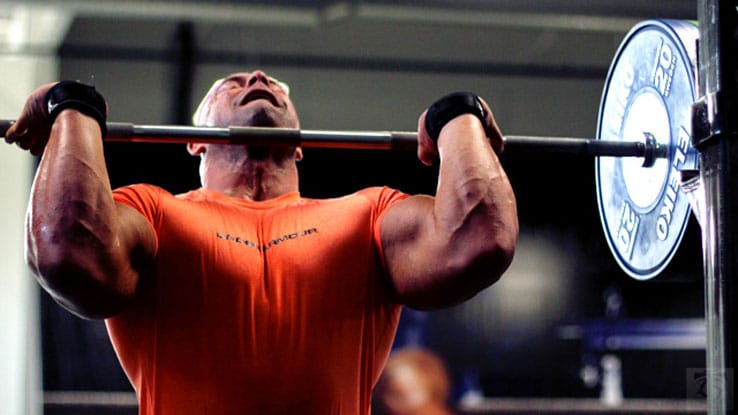
A push press exercise involves using your body's momentum to launch the barbell over your head. It's a full-body exercise that works your glutes, core, pecs, triceps, deltoids, quads, and lower back muscles in one movement [2].
This helps to improve your overall strength and physicality and is often used by advanced lifters as an effective compound exercise.
Further Reading - Barbell Vs Dumbbell Shoulder Press
Benefits
When it comes to performing the push press, there are a wide range of benefits. Some of the best include:
Full Body Engagement
The push press works every muscle group in the body, including your shoulders, triceps, quadriceps, glutes and core. As it works every area, it allows you to develop full body strength which carries over to everyday life and many other lifts.
Increased Power and Explosiveness
The push press is an explosive movement that requires a lot of power generation to drive the weight overhead. I've found this exercise to be extremely beneficial for athletes and anyone looking to improve their performance in other sports or activities such as boxing, basketball, football, and more.
Improved Shoulder Stability and Strength
During the push press, the weight you're lifting is pressed from your upper chest height to overhead. This movement uses a wide range of motion, helping you strengthen your shoulders while improving stability in your shoulder joint.
I've found that working your shoulder joint through a wide range of motion while under load can help prevent shoulder injuries and even improve your posture.
Enhanced Core Stability
The push press uses your entire body (including your core), which requires A LOT of core stability. So by adding this exercise to your workout routine you'll see an improvement in your core strength and stability.
When should you do the push press
The push press is a brilliant compound movement that can be implemented into your workout routines. There are a few scenarios when you should do the push press:
Strength Training
I've always found the push press to be an excellent exercise for developing upper body strength, particularly in your shoulders, triceps, and core. I often give this exercise to clients who want to develop their overall upper body strength.
Power Development
As the push press involves a leg drive, it helps you develop explosive power. This is useful in many sports and athletic activities such as football, basketball, BJJ, MMA, and more. In my opinion, if you participate in sports (no matter your level), you can up your game with this movement.
Overcoming Plateaus
Strict overhead pressing is tough, especially if you're looking to hit a PB. I've often found the push press can help you handle heavier weights and improve your strength due to the leg drive. You'll be able to lift more weight and improve your strength for more controlled movements.
Functional Fitness
Do you participate in CrossFit or use CrossFit-style workouts? If so, the push press can help you improve your performance. During CrossFit, the push press is used as part of your workout (WODs). So by practising the movement, you'll naturally become better at it.
Training for Olympic Weightlifting
The push press is a supportive exercise for the jerk portion of the clean and jerk lift in Olympic weightlifting. As the push press involves lifting the weight overhead, I would often give this to clients to supplement their workouts to develop their strength.
When shouldn't you the push press
While the push press is a brilliant exercise, it's not for everyone. Here are some scenarios when you shouldn't perform the push press:
Injury or Pain
If you've got a shoulder, back, elbow, or wrist injury, or if performing the exercise causes pain, you should avoid the push press. In the past I've had wrist pain and it made this movement difficult.
Poor Technique
If you're unable to perform the push press with proper form, I recommend that you avoid it until you've corrected your form. The best way to learn good form is to use a Personal Trainer, watch tutorials, and to practice with little to no weight.
Practice makes perfect.
Insufficient Strength or Stability
If your shoulders and core muscles aren't strong enough to stabilize the weight you're lifting throughout the movement, you should avoid the push press. In my opinion, the push press requires a solid core, so until you've got a solid base strength, you should leave this exercise out of your program.
Limited Mobility
If you've got limited range of motion in your shoulders, elbows, or wrists, the push press might not be for you. During the movement, your shoulders need to move through a large range of motion, and a lot of mobility is required in your joints.
Pre-existing Health Conditions
Pre-existing health conditions like high blood pressure or heart problems, can rule you out from this movement. Always consult your doctor before performing overhead exercises like the push press. In the past when I've been working with clients post heart attack, overhead movements were avoided.
How To perform The Push Press
To perform a push press, you’ll need a barbell loaded with weight plates.
Start by holding it with both hands at shoulder height, bend your knees slightly, and then push upwards through your legs, swinging the barbell up until your arms are outstretched above you. Pause for a moment, and then lower it back down to the starting position.
The key difference between a push press and an overhead press is that you use your momentum to help press the barbell.
This means you can lift a heavier load because your whole body supports the exercise. It’s more advanced than the overhead press and often used in weightlifting competitions.
Pros And Cons Of Doing Push Press Exercises
Pros
Cons
Overhead Press Overview

The overhead press focuses the effort on your upper body. It targets your shoulders, deltoids, pecs, triceps, and upper back.
It involves pressing the barbell up over your head but in a much more controlled way, focusing the effort on your upper body muscles to keep it controlled throughout.
This helps you develop a strong upper body and large muscles around your shoulder and upper back.
Other Training Options - Best Overhead Press Alternatives
How To Perform The Overhead Press
To perform an overhead press, you’ll need a barbell with some weights on it. Start with the barbell at shoulder height and press it directly upwards until your arms are almost fully extended above you. Pause for a second, and lower back down to starting position.
This is a much more controlled and less explosive movement that isolates specific muscles to build strength in those areas.
However, it doesn't involve your lower body, so you won’t get the same benefits to your legs or core, and it has to be performed with slightly lighter weights.
The overhead press is often performed by bodybuilders as they prefer to have control of the bar throughout the movement.
Pros And Cons Of Doing Overhead Press Exercises
Pros
Cons
Frequently Asked Push And Overhead Press Questions
A free weight push press is a push press that is performed with any kind of free weights. This could be dumbbells, kettlebells, or the classic barbell.
Yes, an overhead press will help to develop your upper back, shoulders, and arms so that pullups are easier to perform.
The average beginner can overhead press 100-120 pounds, but this will quickly improve if you train regularly.
Conclusion
Both overhead and push press exercises are good for building your strength.
A push press is preferred by those looking to improve their overall physicality and uses explosive movements, whereas an overhead press is more controlled and preferred by bodybuilders.
Hopefully this guide has helped explain the key differences, and you now know which exercise is best for you.
References:
1.https://www.healthline.com/nutrition/does-exercise-cause-weight-loss
2.https://my.clevelandclinic.org/health/body/21875-deltoid-muscles
Last Updated on December 29, 2025